Montreal through time
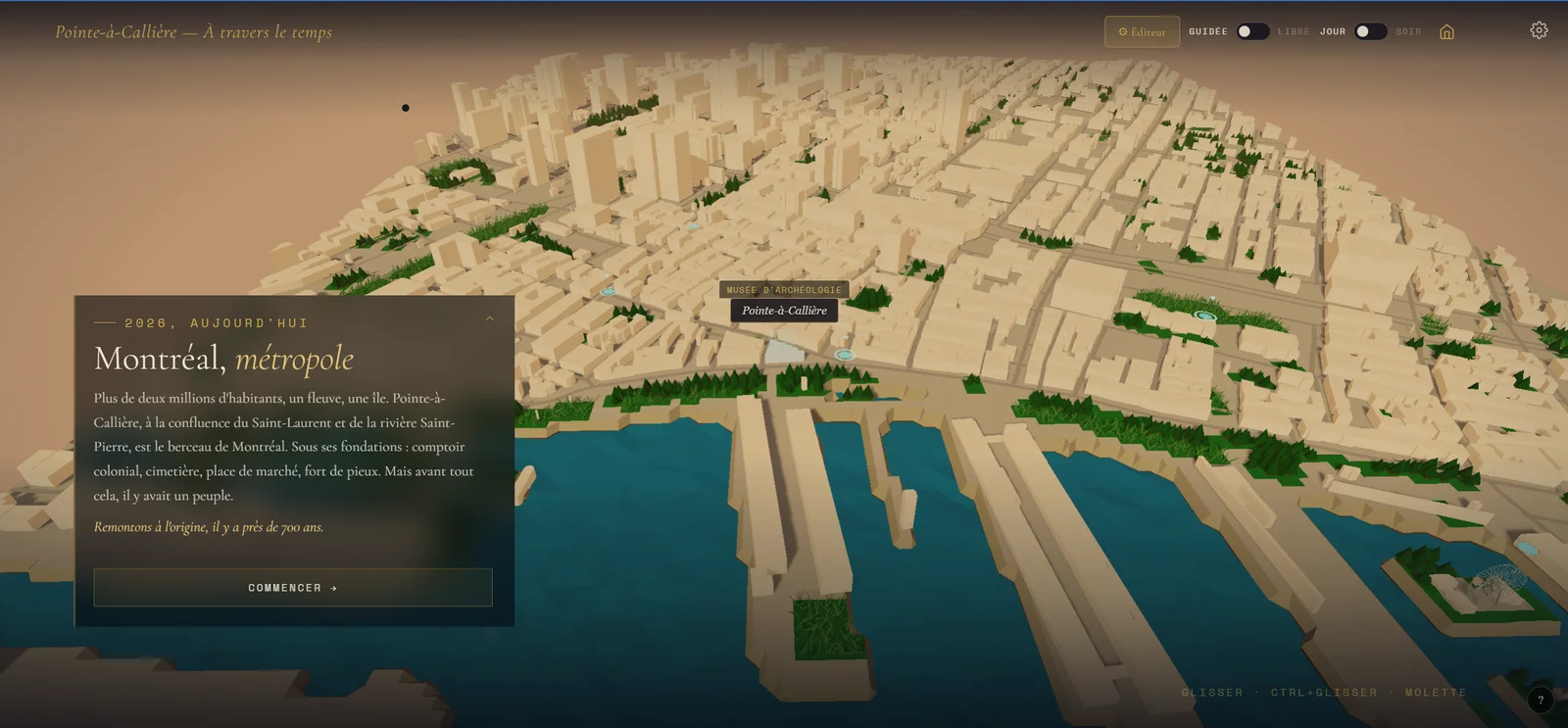
This interactive experience turns Montreal’s history into a territory visitors can explore. From a three-dimensional model of the island, they travel between four defining periods: Hochelaga in 1350, the founding of Ville-Marie in 1642, fortified Montreal in 1760 and the contemporary metropolis in 2026.
With every change of era, the landscape is transformed: buildings emerge or disappear, the city grows denser, roads evolve and the lighting shifts with the story. These transitions make Montreal’s growth visible and reveal the place Pointe-à-Callière holds within its history.
Guided or free exploration
Visitors can follow a narrative journey or explore the model freely. They can move the camera, change eras, switch between day and evening, and select points of interest to discover historical places, buildings and events.
The goal is to make history tangible. Instead of simply viewing a sequence of texts or images, visitors observe the city’s transformations in space and understand how Montreal’s different layers were built on the same ground.
Where history, 3D and programming meet
The project brings together cartography, 3D modelling and WebGL development. Geographic data is prepared in QGIS, buildings and environments are created in Blender, and the experience is assembled and animated with Three.js.
The application runs directly in a web browser and adapts its visual quality to the visitor’s device. Its architecture makes it possible to progressively add new eras, buildings, historical content and forms of storytelling.
Future development
An experience designed to grow
This first version provides the foundation for a broader cultural experience. Planned developments include the addition of the 1701 and 1880 periods, more points of interest, a fuller representation of Pointe-à-Callière’s different pavilions and a narrative thread connecting the eras.
The project could also incorporate audio narration, archival material, video, 360-degree photography and soundscapes specific to each period. Versions for schools, museum kiosks and virtual reality are also being considered to adapt the experience to different audiences and settings.